

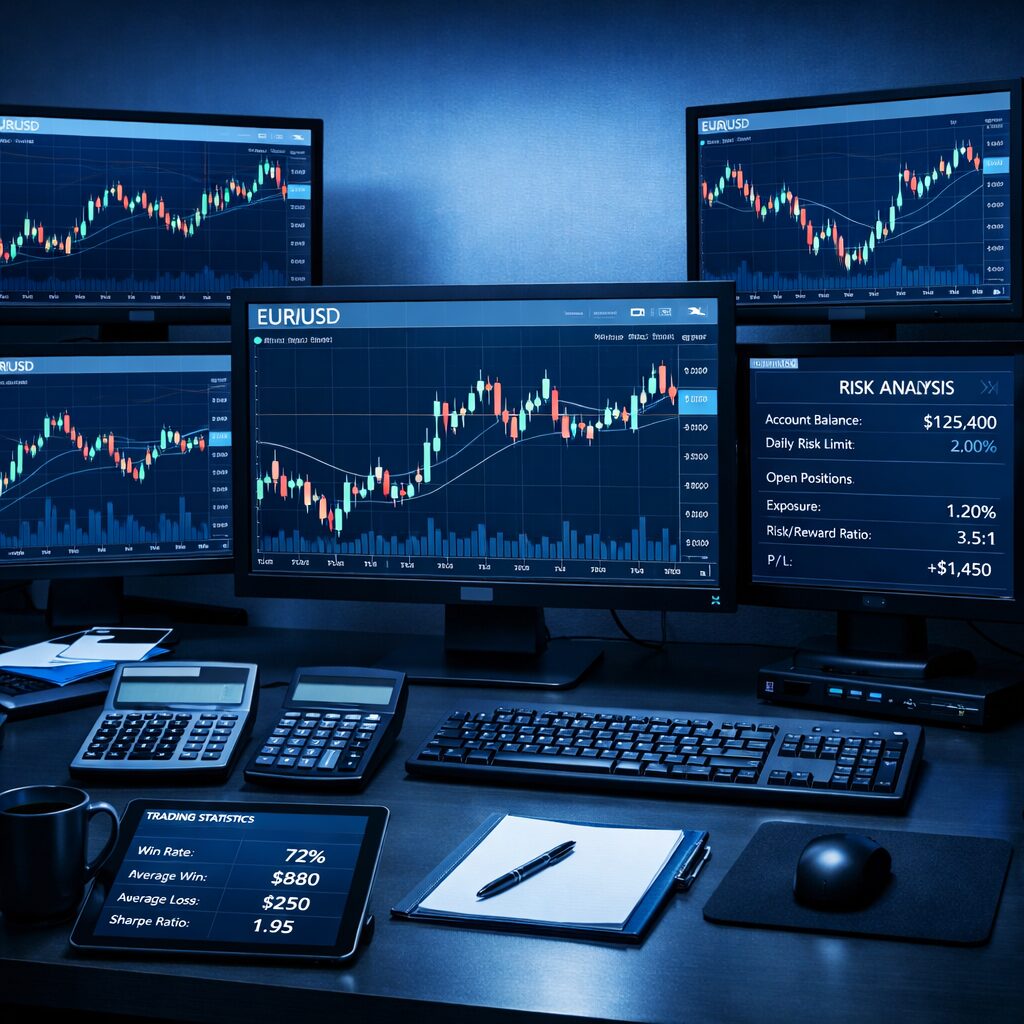
Let’s be honest, the vast majority of us didn’t enter the world of trading out of a love for mathematics or complex equations. We entered in search of financial freedom and investment opportunities. However, there’s a harsh reality in the financial markets: trading is a game of numbers and probabilities. Relying on “intuition” or guesswork to determine the size of a trade or assess risk is the surest path to losing capital.
A simple calculation error in lot size can turn a small losing trade into a disaster that wipes out half your account. The good news is, you don’t need to be a math whiz to trade professionally. By 2026, automated trading calculators would become the secret weapon of the successful trader. These simple tools do the hard work for you, turning guesswork into precision science.
In this article, we will review the 4 most important trading calculators that should be part of your daily routine before opening any trade.
- Pip Value Calculator: The cornerstone of every trade
Before you think about profit, you need to know exactly “how much each move is worth.” That’s where this calculator comes in.
What is a pipe?
In the world of financial markets, we don’t talk in cents or dollars; we talk in “pip.” A pip is short for “percentage in point,” and it’s the standard unit of measurement for the smallest change in a currency’s price.
- In most currencies: it is the fourth decimal place (0.000 1 ).
- In Japanese Yen ( JPY ) pairs: it is an important exception, where the second decimal place is (0.0 1 ).
Why is this calculator a lifesaver?
Many traders make the grave mistake of assuming that “one pip is always worth $10” when trading a standard lot (100,000 units).
This rule only holds true if the second currency in the pair (quote currency) is the US dollar (such as EUR/USD or GBP/USD). However, once you trade other currency pairs, the rules change completely, and that’s where the risk lies.
The value of the point is not fixed, but changes based on three factors:
- The currency pair being traded: The pip value is always calculated in the second currency of the pair. If you are trading USD/CHF, the pip value is in Swiss francs, not US dollars.
- Your account currency: To know your profit or loss, you must convert the pip value from the currency of the pair to your account currency (usually US dollars).
- Current exchange rate: In cross pairs such as EUR/GBP, the conversion of the pip value to dollars depends on the exchange rate of the British pound against the dollar at that moment.
A practical example illustrating the trap:
Let’s assume you decided to risk 50 pips (Stop Loss) on a trade of a standard 1 lot size, and your account is in US dollars.
- Scenario A ( EUR/USD ): The pip value is fixed at $10.
- Expected loss = 50 points x $10 = $500 . (This is what I planned).
- Scenario B ( EUR/GBP ): The counter currency is the British pound, which is more expensive than the dollar. The pip value here could be around $13 (depending on the GBP/USD exchange rate).
- Expected loss = 50 points × $13 = $650 .
- Scenario C ( USD/CAD ): The counter currency is the Canadian dollar, which is cheaper than the US dollar. The pip value might be around $7.50.
- Expected loss = 50 points × $7.5 = $375 .
Result: In scenario (B), you lost an additional $150 that you hadn’t accounted for simply because you didn’t calculate the point value accurately!
The pip value calculator performs these complex calculations and instant conversions at the touch of a button, to give you the exact figure to risk in your account currency before you enter the market.
- Margin Calculator: Protecting you from the scary “call”
If leverage is the “power” that drives your account, then margin is the “fuel” that every position you open consumes. Understanding the relationship between them is the dividing line between an account that grows and one that evaporates.
Understanding leverage and margin: two sides of the same coin
Many people confuse margin with cost. Margin is not a fee you pay to the broker ; it is a “security” or “good faith deposit” that is temporarily held from your account to ensure the trade remains open.
- Leverage is a tool that multiplies your purchasing power. A 1:100 leverage means that every dollar you own can buy $100 worth of goods in the market.
- The required margin is the actual amount of your money that must be available and reserved to cover this purchasing power.
Simply put: the higher the leverage, the less margin needs to be “held,” and vice versa. But the danger lies in forgetting that this held capital is no longer available to absorb losses.
How does this calculator protect you? (Gold and oil scenario)
Imagine the following scenario: You have $5,000 in your account, and you see two golden opportunities: buying gold (XAUUSD) and buying crude oil.
Without using a calculator, you might think, “I have $5,000; that’s a lot of money. I’ll open a trade of 1 lot for each.” But you’ve overlooked the fact that leverage on commodities (like gold and oil) is often lower than on currencies, meaning it requires a much larger margin (deposit).
What will the margin calculator tell you?
- First trade (gold): To open 1 lot, the broker may require you to reserve $1,500 as margin.
- The second deal (oil): To open 1 lot, you may be required to reserve another $1,500.
The shocking result:
- Total Reserved Margin (Used Margin): $3,000 .
- Available margin (Free Margin): Only $2,000 .
You think you have $5,000 to withstand market fluctuations, but in reality, you only have $2,000 (available margin) to absorb any adverse movement. If the market moves even slightly against you, this available margin will be gone in a flash.
The biggest nightmare: Margin Call
When the available margin runs out and the margin level approaches a certain percentage (e.g., 50% or 30%), the broker’s automated system intervenes and performs a forced stop – out on your trades, starting with the most losing ones, to protect the company’s funds.
Using a margin calculator before opening trades gives you a clear picture of the future: “If I open these trades, I will have X available margin left. Is this enough to withstand daily market fluctuations?” If the answer is no, you need to reduce the trade size immediately.
- Position Size Calculator: The most important tool for risk management
This is the tool that separates professionals from amateurs. If you’re only going to use one calculator, let it be this one.
The equation for survival in the market
The golden rule of risk management states: “Never risk more than 1% to 2% of your capital on a single trade .” But how do you apply this in practice?
Scenario:
- Your account balance: $5,000.
- Allowed risk (1%): $50.
- The required stop loss based on your technical analysis is: 50 points.
Question: What is the lot size I should open the trade with so that if I lose 50 points, I only lose $50?
Instead of guessing and randomly opening a “0.1 lot”, the calculator tells you the exact size (it might be 0.10, 0.08 or 0.12 depending on the currency pair).
You can access a comprehensive suite of advanced trading and technical analysis tools to ensure the accuracy of your trades through the CMTrading client portal , where we provide everything you need to manage your account professionally.
- Profit & Loss Calculator: Planning for the Future
See the result before starting
Before you click the buy or sell button, you need to know your target. The profit and loss calculator allows you to enter your entry price, stop-loss price, and take-profit price.
The result will be displayed immediately:
- If the deal goes through, I will earn: $200.
- If the deal fails, I will lose: $100.
This immediately helps you calculate the ” risk/reward ratio “ . If you find that you are risking $100 to earn only $50, the numbers will clearly tell you: “This is a bad deal, don’t go in.”
How do you integrate these tools into your daily routine?
To maximize your benefit, make using these calculators a mandatory routine, a “checklist” before every trade:
- Analyze the chart: Determine the entry point and stop loss (technically).
- Use the trade size calculator: Enter your stop loss and account balance to find the appropriate lot size.
- Check your margin calculator: Make sure you have sufficient free margin.
- Execute the deal: Now you can enter with complete confidence.
For more details on financial risk management concepts and advanced terminology, Investopedia is a trusted global reference for accurately explaining financial terms.
In conclusion: Accuracy is the key to continuity.
Trading in financial markets is not a place for guesswork or “rounding around”. The difference between a winning trader and a losing trader often lies not in a magic strategy, but in mathematical discipline .
These tools aren’t a luxury; they’re your shields that protect your capital. When you know exactly how much you’ll lose in the worst-case scenario and how much you’ll gain in the best-case scenario, and you’re confident your account is safe from margin calls, you trade with a clear, stress-free mind. Start using the numbers to your advantage today.
Frequently Asked Questions (FAQ)
- Q1: Are these calculators 100% accurate?
- A: Yes, provided that you accurately enter the “current exchange rate” of the currency at the time of calculation, and that you select the correct currency for the calculation (dollar, euro, etc.).
- Q2: Do I need to use a calculator for every transaction?
- A: Yes, it is highly recommended, especially the trade size calculator . Each trade has different conditions (different stop loss), and therefore requires a different contract size to maintain the same risk ratio (1%).
- Q3: Does the MetaTrader platform provide these calculators?
A: The MT4/MT5 platform performs some calculations automatically after a trade is opened, but using external calculators before opening a trade is more important because it gives you the ability to plan and make the right decision beforehand.